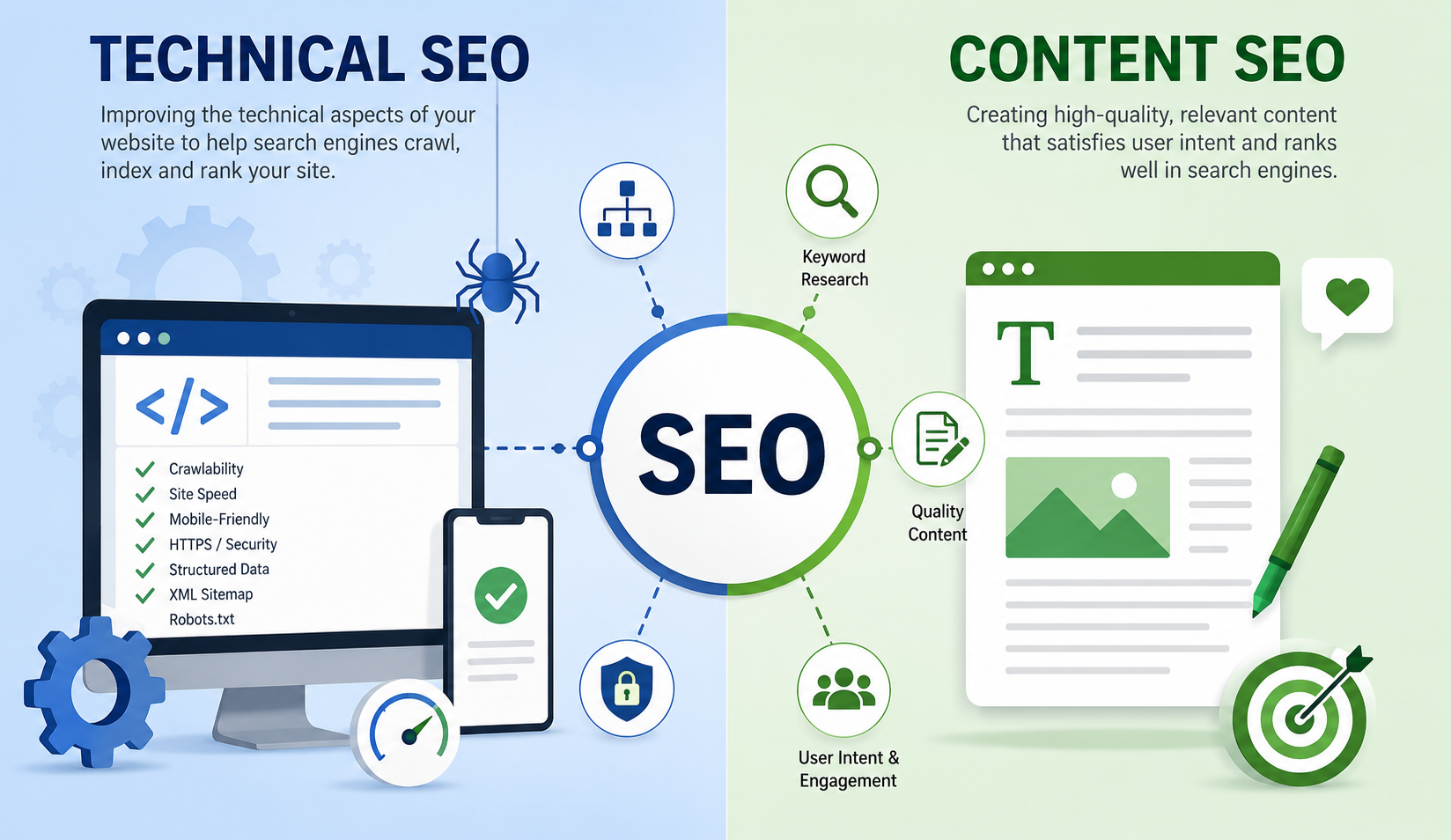
Search engine optimization is no longer just about adding keywords to a page or fixing a few broken links. Modern SEO is built on two major pillars: technical SEO and content SEO. Both influence rankings, visibility, and organic traffic, but they solve very different problems.
Many websites publish excellent content yet fail to rank because search engines struggle to crawl or index their pages. Others invest heavily in technical optimization but still cannot compete because their content lacks topical relevance, semantic depth, or search intent alignment.
Understanding the difference between technical SEO and content SEO is essential if you want sustainable rankings in modern search results. More importantly, knowing how they work together can determine whether your site becomes visible or disappears beneath competitors.
What Is Technical SEO?
Technical SEO focuses on optimizing a website’s infrastructure so that search engines can crawl, render, index, and understand pages efficiently.
In simple terms, technical SEO ensures that search engines can access your content without obstacles.
It deals with backend systems, website architecture, performance signals, and machine-readable optimization rather than the written content itself.
Key Elements of Technical SEO
Technical SEO includes:
- Crawlability optimization
- XML sitemaps
- Robots.txt management
- Canonical tags
- Mobile-first indexing
- Structured data
- Core Web Vitals
- Page speed optimization
- Internal linking structure
- HTTPS security
- JavaScript rendering optimization
- Crawl budget efficiency
- Redirect management
For example, a page with excellent content may never rank if it returns server errors, loads slowly, or is blocked from indexing.
How Technical SEO Helps Search Engines
Search engines like Google use crawlers to discover and process pages. Technical SEO improves this process by removing barriers that interfere with indexing and rendering.
A technically optimized site helps search engines:
- Discover pages faster
- Understand content hierarchy
- Process structured data
- Evaluate user experience signals
- Consolidate ranking signals correctly
Without technical optimization, even high-quality content can remain invisible in search results.
Crawlability vs Indexability
These two concepts are often confused.
- Crawlability refers to whether search engine bots can access a page.
- Indexability refers to whether the page is eligible to appear in search results.
A page can be crawlable but not indexable if it contains a noindex tag or duplicate content issues.
This distinction matters because many content-heavy websites suffer from hidden indexation bottlenecks that prevent rankings despite publishing valuable information.
What Is Content SEO?
Content SEO focuses on optimizing information so it matches user intent, semantic relevance, and search engine understanding.
Instead of infrastructure, content SEO centers on what users read and how search engines interpret meaning.
It involves:
- Semantic keyword optimization
- Search intent mapping
- Entity optimization
- Topic clusters
- Topical authority
- Internal topical linking
- Content freshness
- NLP optimization
- Readability improvements
- Contextual relevance
Content SEO is what helps a page become valuable, useful, and relevant for a specific query.
Search Intent Is the Core of Content SEO
Modern algorithms do not rank pages simply because they contain keywords. They rank pages that best satisfy search intent.
For example, someone searching “difference between technical SEO and content SEO” wants:
- Definitions
- Comparisons
- Real-world examples
- Use cases
- SEO best practices
- Strategic insights
If a page only provides shallow definitions, it will struggle to compete against semantically rich content.
Semantic SEO and NLP Optimization
Search engines increasingly rely on Natural Language Processing and entity recognition.
Algorithms such as RankBrain, BERT, and MUM analyze context, relationships, and semantic meaning rather than isolated keywords.
That is why content optimization now includes:
- Entity associations
- Context vectors
- Topic completeness
- Semantic relationships
- Information gain
- Search intent layering
A strong content SEO strategy builds topical authority instead of targeting isolated keywords.
Technical SEO vs Content SEO: The Core Difference
The simplest way to understand the difference is this:
| Technical SEO | Content SEO |
|---|---|
| Improves accessibility | Improves relevance |
| Helps search engines crawl pages | Helps users and search engines understand meaning |
| Focuses on infrastructure | Focuses on information |
| Optimizes backend systems | Optimizes written content |
| Enhances site performance | Enhances topical depth |
| Supports ranking eligibility | Supports ranking strength |
Technical SEO makes content accessible.
Content SEO makes content valuable.
Both are necessary.
Why Great Content Still Fails to Rank
One of the most common SEO problems occurs when websites publish strong articles that never gain visibility.
Several technical barriers can prevent rankings:
Poor Crawl Efficiency
Large websites often waste crawl budget on:
- Duplicate URLs
- Parameter pages
- Thin archives
- Broken redirects
- Faceted navigation
As a result, important pages are discovered slowly or ignored completely.
Rendering Problems
JavaScript-heavy websites sometimes fail because search engines cannot properly render critical content.
This issue is common in modern frameworks where important information loads after scripts execute.
Weak Internal Linking
Orphan pages with no internal links become difficult for crawlers to discover.
A contextual internal linking strategy helps consolidate ranking signals and improve crawl paths.
Slow Page Speed
Core Web Vitals affect user engagement and search performance.
If a page loads slowly, users leave faster, increasing bounce signals and reducing engagement metrics.
Why Technically Healthy Sites Still Do Not Rank
The opposite problem also exists.
A technically perfect website may still fail because its content lacks semantic depth and topical relevance.
Thin Content
Thin pages provide minimal information and fail to satisfy user expectations.
Modern search engines prioritize content that demonstrates expertise, usefulness, and completeness.
Weak Search Intent Matching
A page targeting informational queries with transactional language often performs poorly.
Search intent fragmentation happens when content fails to align with the actual purpose behind a query.
Poor Semantic Coverage
Content that repeats one keyword without covering related entities and concepts appears incomplete.
For example, an article about content SEO should naturally discuss:
- Semantic search
- NLP optimization
- Topical authority
- Entity SEO
- Search intent
- Passage indexing
Without contextual depth, rankings become unstable.
How Technical SEO and Content SEO Work Together
Technical SEO and content SEO are not competing strategies. They function as interconnected systems.
A strong SEO framework combines:
- Crawl efficiency
- Semantic relevance
- Information hierarchy
- User experience optimization
- Content discoverability
Think of technical SEO as the foundation of a building and content SEO as the structure people actually use.
Without the foundation, the structure collapses.
Without the structure, the foundation has no value.
Internal Linking as a Shared Layer
Internal linking connects technical architecture with semantic optimization.
A well-designed internal linking system:
- Improves crawl depth
- Distributes authority
- Reinforces topic relationships
- Enhances contextual relevance
- Supports topic clusters
This is especially important for topical authority SEO strategies.
The Role of Structured Data in Content Visibility
Structured data helps search engines interpret content more accurately.
Schema markup can clarify:
- Articles
- FAQs
- Products
- Reviews
- Organizations
- Breadcrumbs
This machine-readable content optimization improves semantic understanding and may increase eligibility for rich results.
Tools like Google Search Console often reveal indexing and enhancement opportunities related to structured data implementation.
Also read: How much does it cost to start a caregiver business today plan
Technical SEO Factors That Directly Affect Content Rankings
Several technical elements influence content performance more than many site owners realize.
Canonicalization
Improper canonical tags create duplicate content confusion.
Search engines may struggle to determine which version should rank.
Crawl Path Optimization
Deep pages buried under multiple clicks often receive less crawl attention.
A flatter architecture improves discoverability.
Mobile-First Indexing
Most indexing now occurs from mobile versions of websites.
If mobile usability is poor, rankings can suffer even when desktop performance is strong.
Server Response Codes
Frequent 404, 500, or redirect chain issues reduce crawl efficiency and weaken user experience.
Advanced Semantic SEO Concepts Competitors Often Miss
Many articles stop at basic comparisons. However, modern ranking systems rely heavily on semantic understanding.
Information Gain
Search engines favor pages that contribute unique value instead of repeating existing content.
Information gain optimization means providing:
- New insights
- Better organization
- Deeper explanations
- Fresh examples
- Advanced context
This is especially important for competitive SEO topics.
Passage Ranking Optimization
Search engines can rank individual sections of content independently.
Clear heading structures and semantic chunking improve passage retrieval optimization.
That is why well-organized content with descriptive H2 and H3 headings performs better in featured snippets and AI-generated summaries.
Entity-Based SEO
Search engines increasingly evaluate relationships between entities instead of isolated keywords.
For example, a complete SEO article should naturally connect entities such as:
- Ahrefs
- Semrush
- Screaming Frog
- Knowledge Graph
- Core Web Vitals
- XML sitemaps
- topical authority
This contextual network strengthens semantic relevance.
Technical SEO vs Content SEO for Different Website Types
New Websites
New sites often benefit from prioritizing content SEO first.
Without valuable content, technical optimization alone cannot generate visibility.
However, basic technical health remains essential from the start.
Enterprise Websites
Large enterprise websites require stronger technical SEO management because crawl budget and indexation become major challenges.
Issues like duplicate URLs, faceted navigation, and renderability can severely impact large-scale indexing.
Content Publishers
Publishers should focus heavily on:
- Topic clusters
- Semantic internal linking
- Content freshness
- Passage indexing
- Information hierarchy
These factors improve topical graph optimization and semantic crawl efficiency.
Common SEO Mistakes Businesses Make
Treating Technical SEO as a One-Time Task
Technical SEO requires continuous monitoring.
New issues constantly appear through:
- CMS updates
- Plugin conflicts
- Redirect changes
- JavaScript modifications
- URL restructuring
Writing for Keywords Instead of Topics
Keyword stuffing reduces readability and semantic quality.
Search engines now evaluate contextual relevance and entity associations rather than raw repetition.
Ignoring Content Decay
Even strong articles lose visibility over time.
Content freshness signals matter, especially in evolving industries.
Regular updates improve search relevance and engagement metrics.
How to Build a Balanced SEO Strategy
The best SEO strategies combine technical stability with semantic depth.
Step 1: Fix Crawlability Issues
Start with:
- XML sitemap optimization
- Robots.txt review
- Redirect cleanup
- Broken link fixes
- Crawl depth analysis
Tools like Screaming Frog can help identify hidden technical barriers.
Step 2: Build Topic Clusters
Instead of isolated pages, create interconnected content hubs around core topics.
This improves:
- Semantic relevance
- Internal topical linking
- Topical authority
- Crawl efficiency
Step 3: Optimize for Search Intent
Match content format with query intent.
Examples include:
- Informational guides
- Comparison articles
- Tutorials
- Definitions
- Commercial research pages
Step 4: Improve User Experience
SEO increasingly overlaps with usability.
Improve:
- Mobile responsiveness
- Readability
- Navigation
- Load speed
- Visual hierarchy
Step 5: Strengthen Entity Signals
Include contextual references naturally throughout content.
Entity optimization helps search engines understand topical relationships more accurately.
Which Is More Important: Technical SEO or Content SEO?
Neither is universally more important.
The answer depends on the current weakness of a website.
- If search engines cannot access pages properly, technical SEO becomes the priority.
- If pages are indexed but fail to rank competitively, content SEO usually needs improvement.
In most cases, sustainable rankings require both.
Technical SEO creates accessibility.
Content SEO creates authority.
Together, they create search visibility.
FAQS: Technical SEO and Content SEO
Can good content rank without technical SEO?
Sometimes, but rankings are usually limited. Technical issues such as slow performance, poor crawlability, and indexing problems can prevent strong content from reaching its full visibility potential.
Is technical SEO part of on-page SEO?
Technical SEO overlaps with on-page SEO in areas like structured data and HTML optimization, but it primarily focuses on infrastructure rather than content quality.
How does page speed affect content rankings?
Slow pages reduce engagement metrics and user satisfaction. Poor performance can increase bounce rates and negatively affect rankings, especially on mobile devices.
Why do indexed pages still fail to rank?
Indexed pages may lack semantic depth, search intent alignment, entity optimization, or topical authority. Being indexed only means a page is eligible to appear in search results, not guaranteed to rank well.
How do entities improve content SEO?
Entities help search engines understand context and relationships between concepts. This improves semantic relevance and strengthens topical authority signals.
Conclusion
The difference between technical SEO and content SEO comes down to accessibility versus relevance.
Technical SEO ensures search engines can crawl, render, and index pages efficiently. Content SEO ensures those pages satisfy user intent, provide semantic depth, and demonstrate topical authority.
Modern search algorithms evaluate both simultaneously.
A technically optimized site without valuable content struggles to compete. High-quality content without strong technical foundations often remains invisible.
The strongest SEO strategy combines:
- Crawl efficiency
- Semantic relevance
- Search intent optimization
- Structured architecture
- Entity-driven content
- User experience improvements
Websites that integrate both technical precision and content depth are far more likely to achieve long-term rankings, featured snippets, AI Overview visibility, and sustainable organic traffic growth.