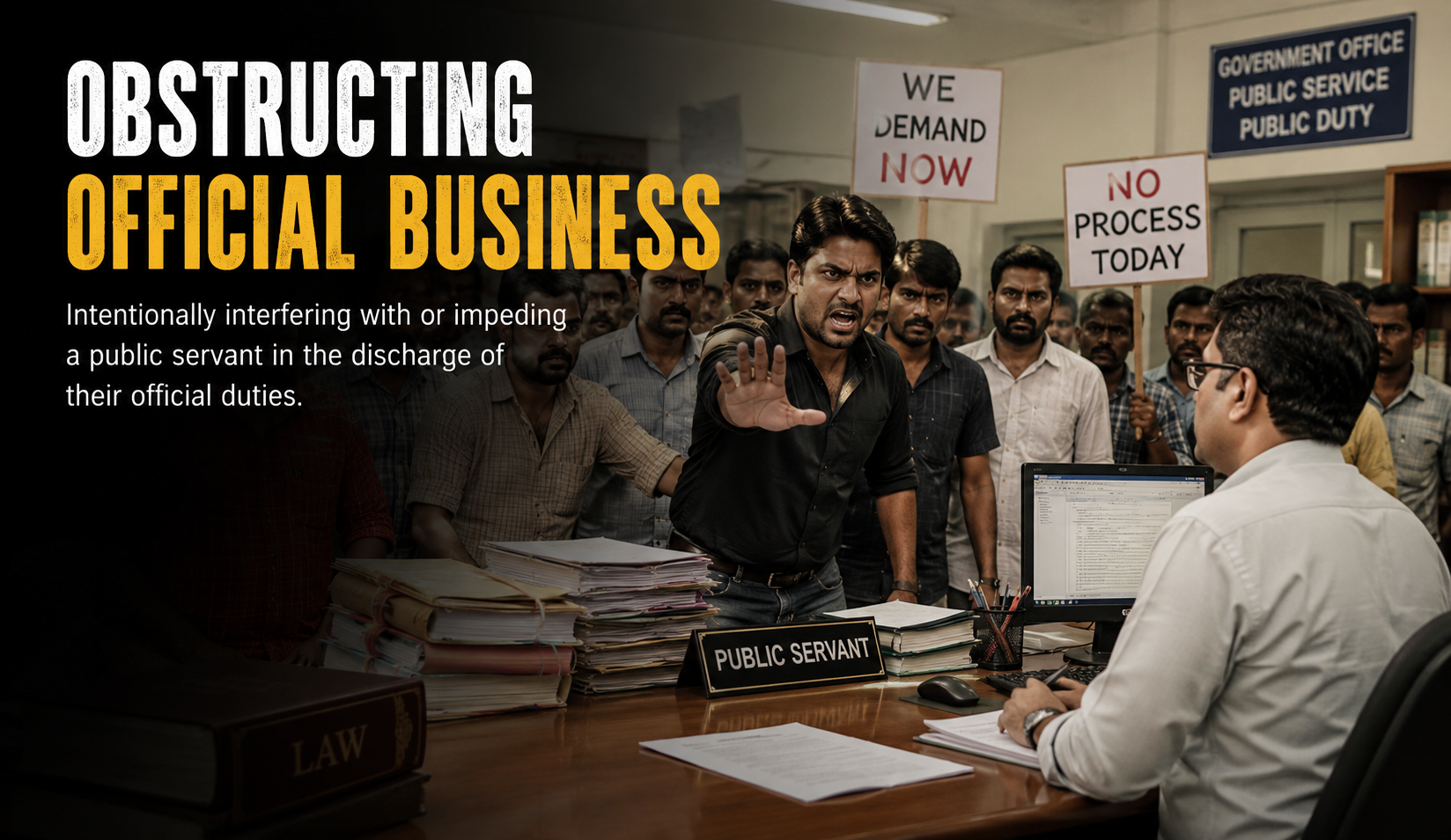
When people hear the term “obstructing official business,” it often sounds vague or overly technical. In reality, it refers to a very specific type of criminal conduct involving interference with law enforcement or other government officials while they are performing lawful duties. The confusion usually comes from how broadly the term can be applied in real-life encounters.
This guide breaks everything down in simple language, so you understand what actually counts as obstruction, what doesn’t, and how courts interpret it in practice.
Legal Definition of Obstructing Official Business
In criminal law, obstructing official business generally refers to any action that intentionally interferes with a public official—most commonly a police officer—while they are carrying out lawful duties.
A clear definition used in many legal systems is:
Obstructing official business is the intentional act of hindering, delaying, or preventing a public official from performing lawful duties through physical interference, deception, or unlawful resistance.
The key idea is interference. Not disagreement. Not annoyance. Actual disruption of duty.
In most jurisdictions, this concept falls under broader categories of criminal interference charges and overlaps with concepts like obstruction of justice and resisting arrest.
What Counts as Obstruction of Official Business
Not every interaction with law enforcement becomes a criminal offense. Courts usually look for behavior that crosses a specific threshold.
Physical Interference
This is the most obvious form and includes actions such as:
- Blocking an officer from entering a scene
- Physically standing in the way during an arrest
- Preventing access to a crime scene or suspect
- Grabbing, pushing, or restraining an officer
These actions clearly fall under physical obstruction conduct and are almost always treated seriously.
Verbal Interference
Speech alone is more complex. In many systems, words can become obstruction if they actively disrupt official duties.
Examples include:
- Giving false information during an active investigation
- Yelling instructions that mislead officers in real time
- Repeatedly interrupting lawful commands during an arrest
However, simple disagreement or criticism usually does not qualify unless it directly interferes with the officer’s ability to act.
Passive Resistance
This is where many cases become legally debated. Passive resistance includes:
- Refusing to move when lawfully ordered
- Going limp during an arrest
- Delaying compliance without physical aggression
Some jurisdictions treat this as active vs passive resistance, and the outcome depends heavily on intent and impact.
What Does NOT Count as Obstruction
A major misconception is that any non-cooperation equals a crime. That is not correct.
Exercising the Right to Remain Silent
You are generally allowed to stay silent during questioning. Silence alone is not obstruction.
Recording Police Activity
In many legal systems, recording officers in public spaces is protected, as long as it does not physically interfere with their duties.
Asking Questions or Seeking Clarification
Confusion or hesitation is not obstruction. The law focuses on intentional interference, not normal human reaction.
Refusing Consent Searches
Simply refusing permission for a search is usually lawful and does not automatically trigger obstruction charges.
Key Elements Prosecutors Must Prove
To convict someone of obstruction, prosecutors usually need to establish three core elements:
1. Lawful Duty of the Officer
The officer must be performing a legitimate official task.
2. Intent (Mens Rea)
There must be intent to interfere. Accidental or misunderstood actions are not enough.
3. Actual Interference
There must be a measurable disruption, delay, or prevention of duty.
This is why intent requirement in obstruction crime is often the central issue in court.
Also read: How Technical SEO and Content SEO Impact Rankings Now Online
Obstruction vs Resisting Arrest vs Evading Arrest
These terms are often confused, but they are legally distinct.
| Offense Type | Core Meaning | Example |
|---|---|---|
| Obstruction of official business | Interfering with official duties | Blocking an officer from accessing a suspect |
| Resisting arrest | Actively opposing arrest | Pulling away or struggling during arrest |
| Evading arrest | Attempting to flee | Running away to avoid detention |
Understanding this difference is important because charges can escalate depending on behavior.
Common Situations Where Obstruction Charges Arise
Traffic Stops
One of the most frequent settings. Charges may arise from:
- Refusing repeated lawful commands
- Interfering during a search or arrest
- Aggressive interruption of officer procedures
Arrest Situations
During arrests, escalation happens quickly if someone:
- Physically resists
- Encourages others to interfere
- Blocks officer movement
Protests and Public Gatherings
Large crowds increase complexity. Issues often involve:
- Crowd blocking emergency access
- Failure to disperse when lawfully ordered
- Group interference with police action
These situations often raise questions about police duty obstruction meaning and lawful protest boundaries.
Penalties and Legal Consequences
The seriousness of obstruction charges varies widely.
Misdemeanor Obstruction
- Short-term detention or jail time
- Fines
- Probation
- Possible record impact
Felony Obstruction
- Longer prison sentences
- Heavier fines
- Long-term criminal record
- Employment and travel consequences
The shift from misdemeanor to felony often depends on whether force, threats, or serious interference occurred.
Defenses Against Obstruction Charges
Not every charge leads to conviction. Common defenses include:
Lack of Intent
If there was no deliberate attempt to interfere, the charge may fail.
Unlawful Police Order
If the officer’s command was not legally justified, non-compliance may not qualify as obstruction.
Constitutional Protections
Actions protected under law—such as free speech or lawful recording—can be strong defenses.
Misunderstanding or Confusion
In fast-moving situations, unclear instructions can lead to accidental noncompliance.
These defenses often relate to statutory interpretation obstruction laws and how courts evaluate intent.
Rights During Police Encounters
Understanding rights helps avoid unnecessary legal escalation.
Right to Remain Silent
You are not required to answer questions beyond basic identification in some jurisdictions.
Protection Against Unlawful Searches
Searches generally require consent, warrant, or legal justification.
Right to Record Public Activity
In many regions, recording officers is protected as long as it does not interfere.
The balance between rights and compliance is where most disputes arise, especially in cases involving lawful duty interference threshold.
Police Discretion and Misuse of Obstruction Charges
In real-world policing, obstruction charges are sometimes used broadly, especially in tense situations.
This leads to what legal scholars sometimes describe as overbroad obstruction charge misuse patterns or “contempt of cop” scenarios, where frustration escalates into arrest decisions.
Courts often later evaluate whether the arrest was supported by actual interference or simply perceived noncompliance.
Real-World Examples of Obstruction
To make it clearer, here are practical scenarios:
- A person physically blocks an officer from reaching a suspect → likely obstruction
- A bystander films police without interfering → not obstruction
- Someone repeatedly interrupts a lawful arrest and misleads officers → may qualify
- A person refuses to move from a restricted area after warning → depends on context
These examples show how fact-specific each case is.
Why Obstruction Laws Exist
The purpose of obstruction laws is not to punish disagreement but to ensure:
- Public officials can perform duties safely
- Investigations are not disrupted
- Arrests and emergency actions are not delayed
- Public order is maintained during critical situations
In legal theory, this connects directly to criminal procedure, where maintaining lawful process integrity is essential.
When Obstruction Becomes Serious
Certain factors increase severity:
- Use of force or threats
- Organized interference by groups
- Obstruction during emergency response
- Repeated refusal after clear lawful warnings
These can elevate charges from simple interference to more serious criminal offenses.
Key Takeaways
Obstructing official business is not about disagreement or questioning authority. It is about intentional interference with lawful government duties.
To summarize:
- Obstruction requires intent and actual interference
- Not all non-cooperation is illegal
- Context matters more than isolated actions
- Rights still apply during police encounters
- Charges can vary from minor to severe depending on behavior
Understanding these boundaries helps reduce unnecessary conflict and clarifies where lawful conduct ends and criminal liability begins.
FAQS: Obstructing official business
What does obstructing official business mean in simple terms?
It means intentionally interfering with a government official, usually a police officer, while they are performing lawful duties.
Can you be charged for arguing with police?
Not usually. But if the argument actively disrupts their work or involves false information during an investigation, it may escalate.
Is filming police considered obstruction?
No, as long as it does not physically interfere with their duties or safety operations.
What is the difference between resisting arrest and obstruction?
Resisting arrest happens during detention, while obstruction involves interference with broader official duties.
Can obstruction charges be dropped?
Yes, if evidence shows lack of intent, unlawful police conduct, or insufficient interference.